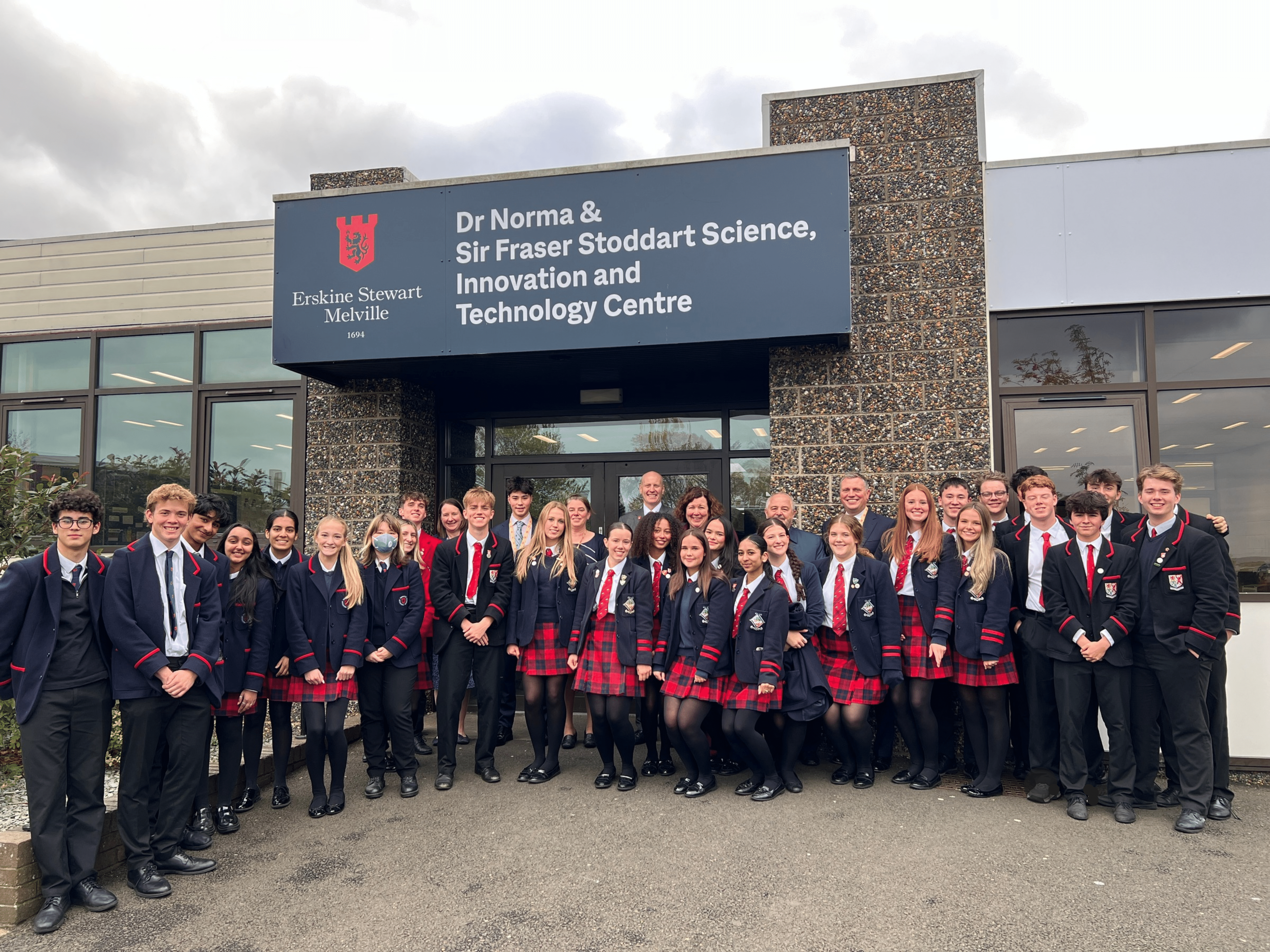
Named in honour of former pupils and Nobel Prize-winning scientist Sir Fraser Stoddart and his wife, Dr Norma Stoddart, the centre will provide students with exceptional facilities for science, innovation and technological learning. The building was officially opened by their daughter, Alison Stoddart, in their memory.
Sir Fraser was one of the world’s most celebrated chemists and awarded the 2016 Nobel Prize in Chemistry for his pioneering work on molecular machines. Throughout his distinguished career, he has published more than 1,000 scientific papers, secured hundreds of patents and held positions at some of the world’s leading universities. He worked closely alongside his wife, fellow scientist Dr Norma Stoddart, until her death in 2004.
On opening the Centre, Alison Stoddart said “I am happy to open the centre in memory of my mother and father. They started their academic lives at the schools and benefitted greatly from the education they received. They were devoted to teaching the next generation of scientists and would be delighted in the knowledge that this centre will inspire future generations.”
The opening marks another milestone in the School’s ongoing transformation, following its move to full co-education in August and substantial investment across its campuses. Among the most significant recent investments was a £1 million gift from the Melville College Trust, which helped fund new science laboratories and a range of wider enhancements across the School estate.
Chair of the Melville College Trust, Mr Stephen Paterson said, “The Trust was very pleased to provide financial support for the new Technology Centre and in particular for it to be associated with our Alumni Sir Fraser Stoddart and Dr Norma Stoddart. Most of us remember the previous merger over 50 years ago and the importance of making the merger of the senior schools a success. I am pleased to see how smoothly it has gone and the benefit that all the senior students will get from the new Technology centre.”
The new centre represents a significant commitment to creating outstanding learning environments that equip young people with the skills, knowledge and confidence to succeed in a rapidly changing world. The building is home to new science laboratories, an extensive Product Design Studio, as well as a Drama studio and multi use classroom spaces.
Anthony Simpson, Principal of Erskine Stewart Melville, said: “The opening of the Dr Norma & Sir Fraser Stoddart Science, Innovation and Technology Centre represents a significant moment in our School’s development. This building reflects our ambition to provide an exceptional STEM education and create opportunities that inspire curiosity, innovation and excellence. We are immensely proud to celebrate the achievements of Sir Fraser and Dr Norma Stoddart through a facility that will support and inspire generations of young people for years to come.”
The School’s commitment to STEM has endured long after Dr Norma and Sir Fraser’s time here. In advance of its transition to full co-education, Erskine Stewart Melville further strengthened its STEM provision through the appointment of Dr Fiona Neave as Director of STEM, with a remit to develop an ambitious and inclusive strategy for science, technology, engineering and mathematics across the School.
The new centre is a key part of that vision, supporting a modern, interdisciplinary approach to learning and creating greater opportunities for pupils to engage with STEM both inside and beyond the classroom. The impact of this sustained focus is already evident, with 40% of the 2026 leavers’ cohort progressing to STEM-related degree programmes at university.
Dr Fiona Neave, Director of STEM, said: “I want STEM to be an integral part of our School identity, empowering learners to develop the knowledge, skills and confidence to succeed in an increasingly technological and interconnected world. To achieve this, we need to work collaboratively with staff, families, employers, universities and our wider community to strengthen STEM learning and create opportunities that extend beyond the classroom.”