Reflecting on your time at MES, were there particular teachers or subjects that first sparked your interest in architecture?
The art department was my sanctuary during my time at Mary Erskine School, a place to hide and get absorbed in the work at hand. When I paint, my head goes quiet and I can’t feel my body so it’s a place of real stillness for me. The design and technology teachers were incredibly inspiring, being one of the only real hands-on practical subjects on offer at the time. I remember our technology project was to design and build a practical light from scratch, paying particular attention to the effect of the light on a wall or surface. A simple, but rich exercise.
After MES, you went on to study architecture at the Edinburgh College of Art. What drew you to that programme?
I had wanted to study fine art via a foundation course somewhere, but my father’s view was that I could paint during my weekends, that this could be a hobby. He encouraged me to consider a course in Architecture, a more formal profession that would likely lead to employment. After securing a place in Glasgow, Dundee and Edinburgh, I contacted a number of Scottish architecture offices to ask if they rated recent graduates from one over the other. Their combined opinion was that the calibre of graduate from Edinburgh was at that time, higher. The ECA architecture course was tough but enjoyable. I found it to be a solid foundation for the world ahead. The tutors were a mix of young visiting tutors from well-known offices and older permanent staff. The University was supportive and flexible, particularly through experience in practice. The architecture department was buried within the School of Art, so I was still surrounded by creativity. ECA was incredibly lively at that time, with exhibitions, discussions, lectures. Corridors heavy with the smell of oil paint, pop up photography, and fashion catwalks. It was a melting pot.
During your architecture degree, you spent time studying in Denmark. Could you share more about that experience and how it influenced your design philosophy?
In my final year, I was lucky enough to win a place on the Erasmus exchange programme to study for a full year in Aarhus, Denmark. It was a natural destination for many reasons, including language accessibility, the scale of the city and quality of the course itself. Danish design is incredible, not just architecture, but this filters down into almost everything you see. In Denmark every creative student in an art school qualifies as an architect, whether they study architecture, furniture design, experimental architecture or jewellery. There is a real purity, high quality and practicality throughout Danish design, yet at the same time it doesn’t lack poetry. I remember the tutors and students being very open, curious, incredibly passionate and dedicated to their craft. Travelling within the seven-year degree course was a good way to break it up and a hugely enriching experience which I would recommend to any student if they have the opportunity.
You went on to spend nearly twenty years practicing architecture, working on everything from private homes and social housing to libraries, universities, hotels, and nationally significant heritage buildings. What guiding principles helped you navigate such a diverse portfolio?
Many of these diverse projects were a product of the varied offices I found myself working in over the years. Upon leaving University I took up employment with a small Edinburgh practice called Morgan McDonnell, the directors were themselves ECA graduates and had an interesting range of projects. Their office was full of laughter and music and I remain grateful for them in taking a chance on me as a graduate because even after seven plus years of study, you are never entirely ready for what the real world can throw at you. From there I moved on to work in bigger offices, Richard Murphy Architects, which gave me the experience I needed to complete my part three qualification. Then John McAslan + Partners in their London office. It was mostly luck of the draw which file landed in my direction, and what team I was on. Architects have to wear many hats in terms of what building typology they design and detail, but the bones of the building process are often the same. Despite the red tape, the heritage projects were always close to my heart. I enjoyed feeling a sense of intimacy with the original architect through the work, like being connected through time by the same purpose, same detail.
‘Studio Cottage’ in the Cotswolds recently won the RIBA Regional Design Award. What unique considerations come with designing around a building of significant historical value?
Studio Cottage is a listed timber cruck frame Arts & Crafts cottage in the Cotswolds. It was little touched for nearly a century when my husband and I bought it as a dilapidated ruin. Living in this old house, pregnant with my first child, and sleeping in a woolly hat year-round to stay warm, I obsessively researched the original occupants, who they were, their ethos and how they once inhabited it. It was built by Alfred Powell in 1932. He and his wife Louise were highly significant in the Arts & Crafts movement, producing early Wedgwood Pottery with a team of local craftspeople from the thatch cottage. This gave way to my idea of connecting the two main buildings together as one and crucially extending the tiny internal footprint. The move was supported by the later uncovering of a key historical image, including the discovery of a former doorway and large feature window hidden behind the old cladding. Each have subsequently been opened up and to dramatic effect. Consultations and permissions were extensive. Historic England required a board-by-board analysis of the external cladding condition to minimise undue timber replacements. I wanted to sandblast the painted brickwork and dark cladding for a lighter finish – so a physical sample of paint was sent to a laboratory to analyse chemical build up, thus proving the first layer of paint had a modern chemical component meaning it could not have been painted during its early years. Full permissions were finally granted, including a new glass link at the heart of the site connecting the two buildings as one. Studio Cottage is testimony that an old dysfunctional building can be truly renewed, allowing a family to live here together for years to come with all the wider contributions to the community this then brings. Shortly after securing permissions, we sold the dream and returned to London, with Ashton Architecture taking the project through to completion under new stewardship. We collected the award in collaboration, proud of our contribution to its legacy.
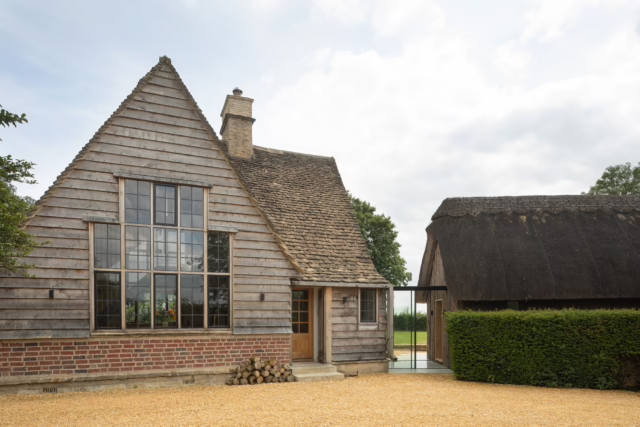
Studio Cottage, © Agnese Sanvito
What prompted your decision to move into the film industry after years of practicing architecture?
Somewhere along the way, or maybe it was always there, I got an itch for something else. Something that utilised my architectural skills but wasn’t as slow and restrictive. I felt I needed to express more of my creative side. As an architect you are trained to question every line, every millimetre. My path unexpectedly crossed with a film industry editor, who then introduced me to an art director, both ECA graduates. The art director described a typical day in a television art department and it sounded like a dream job to me, creative, varied, high pressure. She kindly let me join her with a week of work experience on a kids’ television production. She subsequently became something of a mentor to me and an inspiring example of a successful working mother. After that – I was hooked. I fell in love with the magic of reading a script and creating a world for it to exist in. I quit my job and joined the circus of film and television. Whilst I still dapple in architectural commissions here and there, through film work I get to work all over the world, I’m currently based on the Gold Coast of Australia living with my husband and three children and every day is different.
From your perspective, what are the key similarities and differences between architectural practice and art direction for film?
Whether designing for a stage or for the real world, you are effectively still designing, drawing and building a physical environment. The design process and computer software used to draw and visualise are largely the same. Both operate to a budget. The real world is controlled by planning authorities, building control, the extremities. It has to be safe, to function, to fit, to be sustainable, warm and watertight, to have a certain longevity. A stage build requires no formal permission other than that of the director, and the total cost to be signed off by the producers. There is a health and safety element, but this is mostly common sense. Stage builds are usually built within a huge warehouse space using timber sheets as walls or ‘flattage’, the rooms are made without a ceiling to enable the gaffer to hang his overhead lighting rigs to give the environment light and sometimes simulate a specific time and location. For example, we might be filming in reality on a grey November morning in Pinewood studios but the on-film environment could be high summer, mid-day Afghanistan, followed by a night scene in a bar etc. It can be as simple or as complex as you can imagine and afford. Sometimes the walls are rigged with special effects for things to happen in the scene, such as explosions or gunshots. Replacement segments for before and after. Elements can interchange to demonstrate the passage of time. There are almost always removable segments to accommodate various camera positions. Paint and paint finishes can read differently on camera than in reality. This opens up a whole world of creativity, often tied to a character or the story. Then there is the dressing, which is generally done in layers to make it as realistic as possible. Fundamentally, an art department serves to help the viewer of the film or television show to believe in what they are watching. Whilst it almost always ends up in a skip at the end of the shoot, you could argue that it lives on forever on film. If you are lucky, the work might be seen by millions of viewers all over the world.
Your credits include major films such as The Imitation Game, The BFG, The Hitman’s Bodyguard, and Argylle. Which project pushed you the most creatively, and what made it challenging?
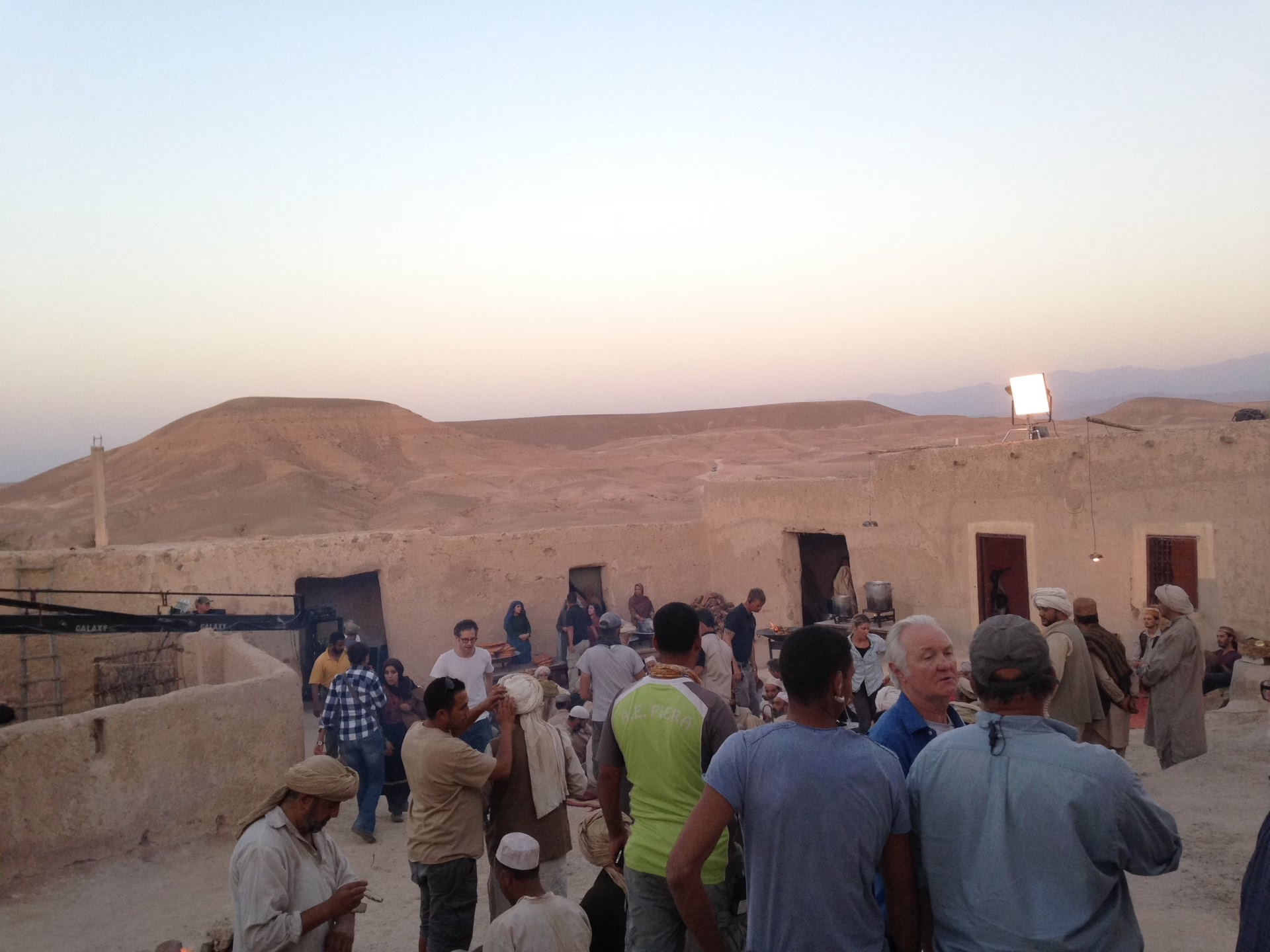
The most challenging film experience under my belt was a film we made in Morocco called, Rock the Kasbah, a lesser-known picture by the renowned film director Barry Levinson (Rain Man, Good Morning Vietnam). The film depicts a down-on-his-luck music manager, who discovers a teenage girl with an extraordinary voice while on a music tour in Afghanistan and takes her to Kabul to compete on the popular television show, ‘Afghan Star’. This was a challenging project in so many ways. Firstly, we were working in extreme heat with no shelter or shade, nothing can prepare you or truly protect you from that. We were filming through Ramadan, with an almost entirely local crew who were forbidden to eat or work for much of the day, despite being on the clock with no alternative workforce lined up. The camera waits for nobody and the job had to be done – just by considerably less people. Furthermore, the cast were A-list: Bruce Willis, Bill Murray, Zoey Deschanel, Kate Hudson. Expectations were high and sometimes impossible to meet. Further to working in the punishing desert, some of our urban locations included the art department dressing full streets in the cities of Rabat and Marrakech, transforming them into bombed-out Afghan war zones. We filled them with sandbags, smoke, rubble, tanks, and brought in American and Taliban cast dressed as soldiers. At one point the crew were receiving death threats from local residents not happy with what they were seeing unfold, many wanting additional payments for their inconvenience. It was a perfect storm of trying to achieve something special under extreme pressure when everything was pitted against you.
What career advice would you offer to emerging designers who are considering a career in architecture?
In addition to the grades, getting onto a course will typically need a solid portfolio of creative artwork showing strong observation and creative skills. I interviewed with armfuls of sketchbooks big and small which helped demonstrate my slightly restless mind and passion. As a school girl I would draw endlessly. From there, success within an architecture course is often attributed to the students who master the art of referencing other architects designs within their own. I was always trying to re-invent the wheel, which was not necessary. After that, getting your feet under a desk in an office is mostly luck and timing, on top of all the other things. In practice, interviewers tend to like paper copies of key projects to point at and sift through. It’s more tactile and they can decide how long to look, discuss or to move on. Whilst I was never a shining example of an A-student at school or university, and my career has taken me in a number of different directions, I feel I have made a creative contribution to the world around me. The best advice I can offer to emerging designers is to work hard and don’t be afraid to change tack.