Reflecting on your school years, when did your interest in product design first begin?
I became interested in art and design late on in my time at the school. Although I was very good at technical drawing and enjoyed making things in the metal and wood shops, I didn’t really think much about a career in design. Looking back, my strength in technical drawing was an indicator of my engineering ability, as well as a brain that works well with spatial awareness, what shapes and surfaces looked like in projections of 2D views, and the ability to create a 3D object in my head before drawing it. In my final year a good friend, Doug Tyson, joined us in the boarding house, and his interest in designing yachts really sparked my passion for design. He was always drawing sailing boat profiles, and it got me interested in car design, so I started designing and making balsa wood models, where I would put motors, batteries and the drivetrain into, to get them working.
After leaving school you decided to spend two years in Berlin, where your dad was stationed. What were those two years like?
It was a great time for me. I got to know a whole new group of friends at Spandau Youth Club, and was part of a very successful football team, with a great team spirit, playing four games per week and even scoring a few goals in the Olympic Stadium. I was also working for the British military government headquarters, drawing up plans in case the Russians invaded West Germany; it was the height of the Cold War in the early eighties. It was a great city, the music of the time was incredible, and I was earning pretty good money, so it was a happy time. Throughout this period, I was also thinking about going to design school so was constantly working on my portfolio.
Your father and grandfather were both known as ‘tinkerers.’ Did their creativity influence your own approach to design and entrepreneurship?
I wouldn’t say my father and grandfather directly shaped my approach to design or entrepreneurship, although I certainly learned a lot from them. My grandfather was pioneering brain‑scanning work for the British government, and my father, an electrical and mechanical engineer, made improvements to tank engineering that were adopted by the Ministry of Defence. Neither, however, turned their ingenuity into commercial ventures of their own.
However, growing up around that kind of creativity mattered, even if I didn’t fully appreciate it at the time. My father taught me enough about cars to do my own repairs, and by the time I left school my grandfather had hard‑wired two ZX Spectrum computers together to create a sort of “supercomputer.” Meanwhile, I was writing BASIC games on the BBC computer at school, yet somehow, I completely missed the future potential of computing and hardware. Had I recognized it, I might not be a designer today!
What did stay with me was the understanding that people can invent new things, turn them into products, and even start companies. I just didn’t see that as a viable path until later in life; everyone graduated and got jobs, right? I’ve always believed that timing is everything, and even 43 years after leaving school, this feels like the right moment to build my own business around my own ideas. Advances in technologies like 3D printing, which have made manufacturing far more accessible, have finally made that leap both possible and compelling.
After two years in Berlin, you enrolled at Manchester Metropolitan University to study Industrial Design. What skills or perspectives did you bring with you from your time in Berlin?
One of the main points I made in my presentation at school when I visited earlier this year, is that not everyone’s brains work the same way; I was always diligent with doing my work, but I could never perform in an exam situation. The two years I spent working in Berlin focused me on delivering to timelines: if the colonel need plans drawn up and printed for a military exercise in three days’ time, it had to get done and done right the first time!
By the time I enrolled at Manchester Polytechnic, as it was then, I had had the experience of six years in the bughut (our nickname for the boarding house), becoming very independent, and being self-motivated through my job responsibilities in Berlin as well as being a key part of a very good championship football team that rarely lost a game. I approached my degree with purpose, with the perspective that this was for me, and I was going to make the most of it. I finished top of the class, but to be honest the degree course was easy; I found out more about myself and my passion for art and design history in my B/TEC diploma course the two years prior.
Tell us about the beginning of your career after graduation from Manchester Polytechnic.
Upon leaving Manchester Poly, I started my design career at Dunlop Footwear, then moved on to Clarks shoes where I spent a little over four years (it also happens to be where I met my wife, Julia!). During this period Reebok called and asked if I would like to interview for a job; I ended up working for three years in Reebok’s China Development Centre. I worked in a factory with 25,000 workers in ZhongShan, across the border from Macau, which is where we lived, crossing the border daily to go to work. That was a special time, being there for the handover of both Macau and Hong Kong to China, and we met many friends we keep in touch with today.
You spent twelve years at Reebok, from 1997 to 2009. What motivated you to stay for so long, and what ultimately prompted your decision to pursue new opportunities?
As my career was developing and I was moving up the ladder, I was able to have a greater impact on the product strategy at Reebok. I did things differently and was always trying to break the rules. I genuinely care(d) about the designers who were in my teams and other teams in the business too, and I cared about the brand, where I looked after the design output for $1.3 billion in sales.
My unique approach allowed me to impact and effect change, always striving to improve and adapt – my mantra was: do the same things, the same way, and you’ll always get the same result. The industry was highly competitive, and the role was extremely high pressure, but I excelled!
Whilst leading the Running team, we created incredible cohesion across the product lines and even invited people from the warehouse who shipped Running product to our meetings, built digital marketing materials and displays to showcase design and consumer concepts. I wanted to do things differently, and in the process created a cohesive performance sport collection that represented the brand, connecting design language and colours in a way that hadn’t been done before. As a result of these efforts, I was promoted to VP, Sport Design. Following that, I then moved to the UK to run the European Design office out of the Reebok stadium in Bolton for two years to help with team building and customer-focused product lines.
My passion for building cohesive collections, leading with inspiration and having a strategic perspective led me to leave Reebok, moving from a very energetic industry and company to A.T. Cross, a well-establish writing instruments company – the contrast couldn’t have been greater, but becoming the Creative Director there gave me the opportunity to have an impact on a brand as a whole. It was all new learning and essential for my growth, which continues to this day.
You’ve designed a wide range of products – from shoes for elite athletes to water bottles. What core principles remain consistent across these projects, and what aspects differ most?
Every product is built the same way. You have an idea, you validate it with consumers and data, you test it, refine it or change it, if necessary and then sell it. You continuously improve the product, your processes and yourself, and you always try to stay ahead of your latest idea: there’s always a better way to build a mousetrap, and the world is a competitive place – somebody will come up with something better. The world evolves, until there’s a revolution and you get rapid change. For example, the iPod versus cassettes and compact discs. I like the play on this: “R/Evolution” to explain the difference between selling versions of what everybody else has, which is Evolution, from year to year, and Bluesky Innovation, where you add the “R” and change the game, and then everybody shifts towards your new paradigm, and it repeats. Whatever the product, whatever the category, the process is the same.
You’ve led teams across several organisations and consistently achieved strong retention. What do you believe contributes to this, and how would you describe your leadership philosophy?
I believe strong retention comes from supporting designers properly and acting as a clear bridge between creative teams and the business. A key part of my role is listening carefully to what stakeholders are really asking for, then translating that into language designers can act on – explaining not just what is needed, but why.
I also genuinely care about the growth and development of people on my teams, give credit where it’s due, and encourage their career objectives. Equally as important, I’m not threatened by their success; I’ll let them succeed and make mistakes, as you learn more from failure than from success.
Finally, I try to create a fun work environment and be relaxed with the time people need to take to do the real stuff that matters with their lives and families too. We don’t have timecards – designers work 24 hours a day, and you don’t turn creativity on at 9am and off again at 5pm!
Even in a leadership role, you remain deeply involved in innovation and design. Why is staying hands-on important to you?
For me, the best way to inspire your team is to wear your passion on your sleeve, and to contribute to the workload to create a direction, perhaps inspire different thinking, challenge the current perspectives and also to roll your sleeves up and do the same work the team is being asked to do. Lead by example, I suppose. Sometimes it’s easier to create something to visually express your idea to the team so that others can see what it is you’re trying to do, rather than try to use words. With 3D printing, it’s now much easier to quickly turn that into something tangible we can discuss as a team.
You’re constantly inventing and experimenting. How do you decide which ideas to develop further?
Good question, and I’m not sure how to answer…when something just feels right, you know! Giini, the business I just launched, started out as a complicated assembly with great functionality, but I ended up scrapping it because it was too expensive and overly complicated for what it was intended to do. Using the material properties is a smarter approach; you are using a single flexible material to replace the mechanical assembly of different parts, and that’s what I launched. Some ideas are clearly ground-breaking because of their novelty, and you really do know you have something. As you begin to do research and form the brand logo and positioning, then check the idea with friends and family, you get a good feel for it – the best response being “why hasn’t that already existed?” And sometimes necessity is the mother of invention; something doesn’t exist, so you create it to solve the problem, and that’s a golden product idea in that it’s both an unmet and an unknown need.
You mention Giini, which is a mechanical snowboard traction device that replaces foam stomp pads. Can you tell us how you came up with the idea and why now felt like the right time to launch your own product?
In a nutshell, I kept falling and felt the most anxiety at the top of the hill when getting off the chairlift with one foot strapped to the snowboard, with the other flailing for traction. You have very little control over where you go, so it’s potluck sliding down the little incline before strapping in for the ride. If there are others on the chair with you and they’re all snowboarders, everybody is scrabbling for control, grabbing each other for support, or just trying to avoid a crash! I realized that existing product called “stomp pads” offer a small amount of control until the grip surface becomes clogged with packed snow, and ices up, quickly becoming ineffective, so I decided to design a better stomp pad, and applied simple material usage and geometry that worked mechanically to hold your boot in place for that essential early control. Although it wasn’t conceived as a free-boarding device, people have been going down the whole run with their “unlocked” foot in Giini.
You hold more than 25 patents. How does the patent process work when you are innovating within a company, and how are you choosing to do things differently with your own business?
Well, this is an irritation I have with how businesses handle intellectual property and compensate their people for it. Innovation happens throughout companies in all areas, not just product creation. If I invent something, my name is on the patent as the inventor, but all rights are assigned to the company I work for. For me, if you don’t compensate people for improving a product, service, or function, through their own intellectual contribution, then sooner or later they will become your competition.
In my own business, as it grows and we add creative horsepower, if a designer invents something, I’m going to give them a share of the sales of that item they invented, and if they have their own ideas for their own products, I’ll let them work on them: after all, they might be the next great innovator and launch new products and services that will benefit us all.
I also believe that when a problem seems difficult to overcome, you need to invoke the art of distraction to let your subconscious solve it for you. I’ll tell my staff – go fishing, go for a walk, build a piece of furniture, play on your Xbox, work on your own project. Your brain is still working on the problem, even though not aware of it, and the solution will come to you: There’s a reason we have “Eureka” moments, just ask Archimedes about his bathtub!
How do you view the role of mentorship in professional development? Have you had mentors who were especially influential in your career?
I have generally walked my own path, but have had great colleagues, only a few of whom have become great friends that I enjoyed working with and respected them for their insights and for treating me with the same respect I show with my staff. Personally, I like to teach, pass on my experience, help people to realize they can do things their own way, and can challenge the way things are.
I think it was Einstein that said: “The one who follows the crowd will usually get no further than the crowd. The one who walks alone, is likely to find themselves in places no one has ever been.
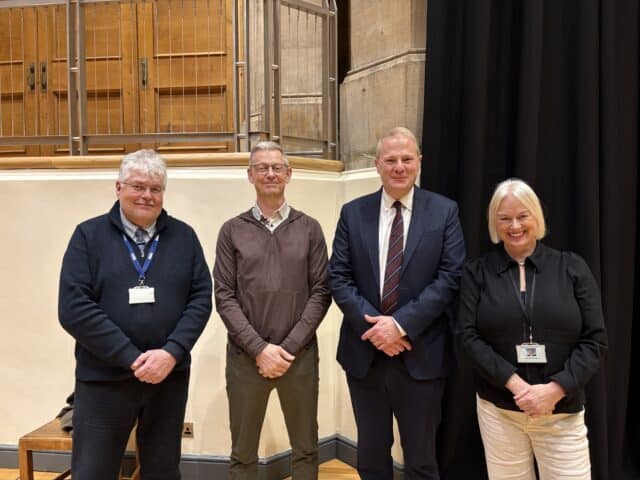
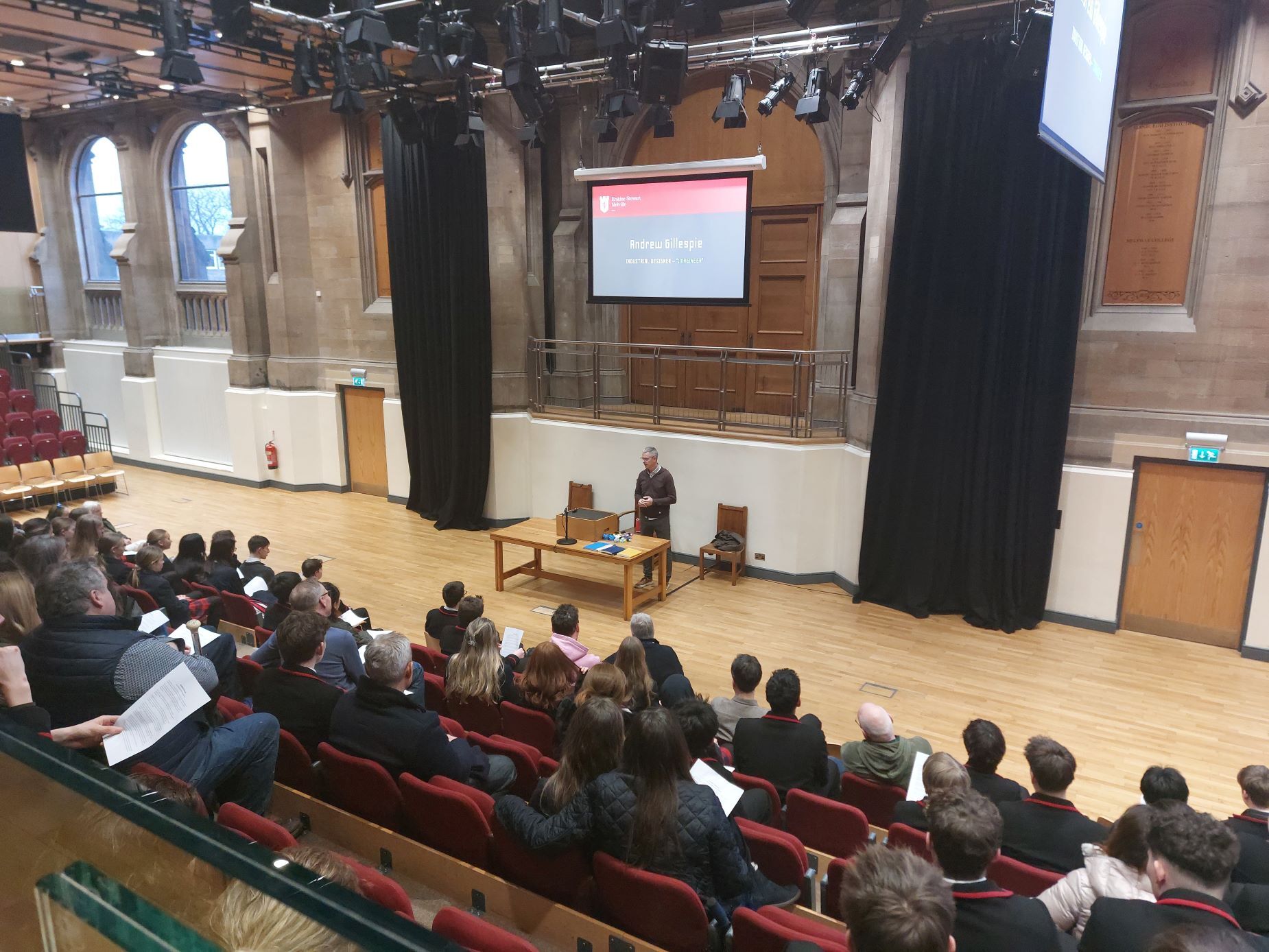
You recently returned to school to meet with students and deliver a presentation in the TFC. What was it like to come back as the one at the front of the room?
Surreal, to put it in one word! Never having felt truly like a pupil that deserved to be at such a wonderful, prestigious school, due to my underwhelming academic achievement, and always having felt like a (the only) fish out of water was the strangest experience standing in that hall, where I used to mumble through hymns, despite enjoying singing – too embarrassed to stand out and sing properly, I think – and especially seeing my name on the first slide next to the School logo.
I was never one for public speaking, but I got used to it as I became more confident in my skills and ability to impact the organizations I worked for. During my presentation at the School, I was simply sharing my experience and attempting to encourage creatives or people with ideas to consider not working for companies that won’t reward them, but to grab the bull by the horns and take a shot, and it was a pleasure for me to do that.
A moment of clarity regarding my ability to speak passionately was when I was at A.T. Cross. The company was presenting itself for sale to seven equity companies. During preparation the Chief Marketing Officer stopped the President during his presentation, which he considered too dry. He said that he thought I should present instead, because “Andrew talks so passionately about the product and the brand”, which is what these companies want to buy. Never having had any experience of this, I did present, and the company was sold. As a result of such experiences, I never use the word “can’t” …anybody can do anything, even start a snowboard business as a 60-year-old rider!
How do you stay ahead of ever-changing technology and integrate new advancements into your design work?
I think I have a young perspective – age is a number, and I have a willingness to learn from even the most junior person in my team. I read a lot, am always interested in new technology because I see myself as an imagineer. As a designer you need to find new ways of doing old things, using technologies from other fields, and helping to shape the future. I don’t have a philosophy of “this is how you do things” and I don’t believe that I know best. I love to learn and am like a sponge, even going back to high school maths, where I find concepts so much easier now, and often scratch my head as to why it was difficult when I was at school.
Finally, what advice would you give students who are considering a career in product design?
Go for it, if that’s your passion – your job should be something you love doing! I’ve had an amazing career, jammed with wonderful experiences, that is still evolving. I won’t be retiring to play golf; there’s always time to create something new, and hopefully something that will make a difference.