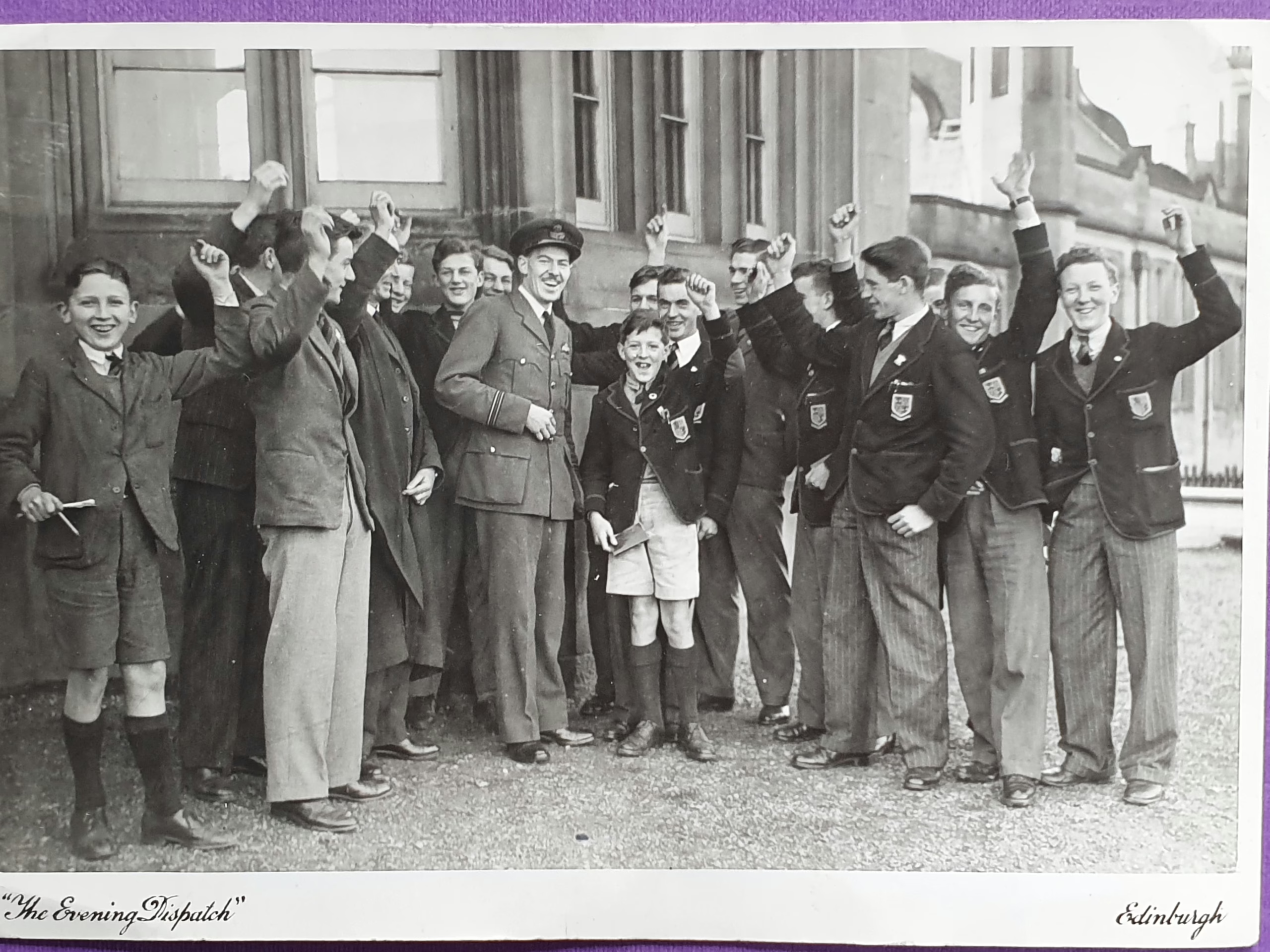
Flight Lieutenant John Cruickshank VC, the last living recipient of the Victoria Cross from the Second World War, passed away in August at the age of 105.
John Cruickshank was born on 20th May 1920 in Aberdeen, attended Aberdeen Grammar School before his family moved to Edinburgh where he first joined the Royal High School and then came to Daniel Stewart’s College in September 1930.
John graduated in 1938 and entered the commercial Bank of Scotland at the start of a banking career, but a few days before his 19th birthday, John enlisted in the Royal Artillery TA as a gunner. On the outbreak of war he was called for service and continued to serve with the Royal Artillery until early 1941, when he applied for a transfer to the Royal Air Force, training as aircrew.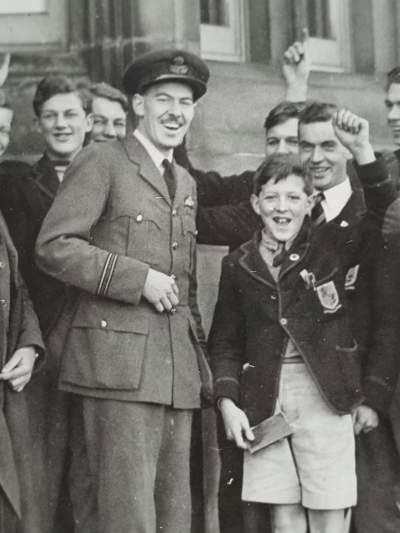
On the 30th June he officially transferred from the 129th Field Regiment Royal Artillery to the RAF’s aircrew reception centre, and on the 19th July 1941 began basic training at No. 11 initial Training Wing and was promoted to Leading Air Craftsman on 1st September. Posted to Toronto, Canada on the 15th September, John underwent elementary pilot training and later commenced his advanced instruction at the US naval flying base at Pensacola. Completing his instruction, he was awarded the pilots wings on the 9th July 1942, and the following day he was commissioned as a Pilot Officer of the Royal Air Force Voluntary Reserve. Arriving in England in early October, John was then posted to 4 Coastal OTU at Invergordon for operational training and crewing where, on the 10th January 1943, he was promoted to Flying Officer. Finally, fully qualified as a flying boat pilot and with his crew, John joined his first operational unit, 210 Squadron, on the 25th March 1943.
John received the Victoria Cross (VC), the highest award for gallantry in the face of the enemy, for his bravery in sinking a German U-boat in July 1944 despite serious injuries. During the attack, the aircraft came under intense fire from the U-boat, resulting in the death of the navigator and injuring four other crew members including John. The aircraft was seriously damaged and pierced in many places below the waterline. Despite being hit in 72 places, including serious wounds to his lungs and lower limbs, John managed to release depth charges and sink the U-boat. Notwithstanding his injuries, he refused morphine to maintain his awareness and guided the less experienced second pilot in landing the aircraft safely after a five-and-a-half-hour flight back to base.
John Cruickshank’s actions were widely praised, with his VC citation highlighting his “determination, fortitude and devotion to duty”. He never returned to operational flying, leaving the RAF in 1946 to continue his banking career. He rarely spoke about his wartime experiences, stating in 2008, “You don’t get involved in that kind of thing thinking of any decorations or any recognition. It was regarded as duty”.
John visited the school on many occasions after the war and was viewed as the ultimate role model for everything the school was about. As Dave Clarke, the school historian, simply put it “He was the best of us”.
During the pandemic, the Imperial War Museums produced a short video about John’s experience which led to him being awarded the V.C. This can be viewed at https://youtu.be/2706zlGw3yQ.
Jon Cooper, ESMS Heritage Officer