How did your early experiences at Melville College and your family background shape your career aspirations?
My father was an architect and had been trained in Sir Robert Lorimer’s, a prolific Scottish architect, office in the 1920s. From a very early age, I was either drawing or leaning on my father’s drawing board as he described how to draw acanthus leaves and columns – classical architectural forms. My dyslexia hindered me from writing, but my father explained how drawing could capture things in a different way.
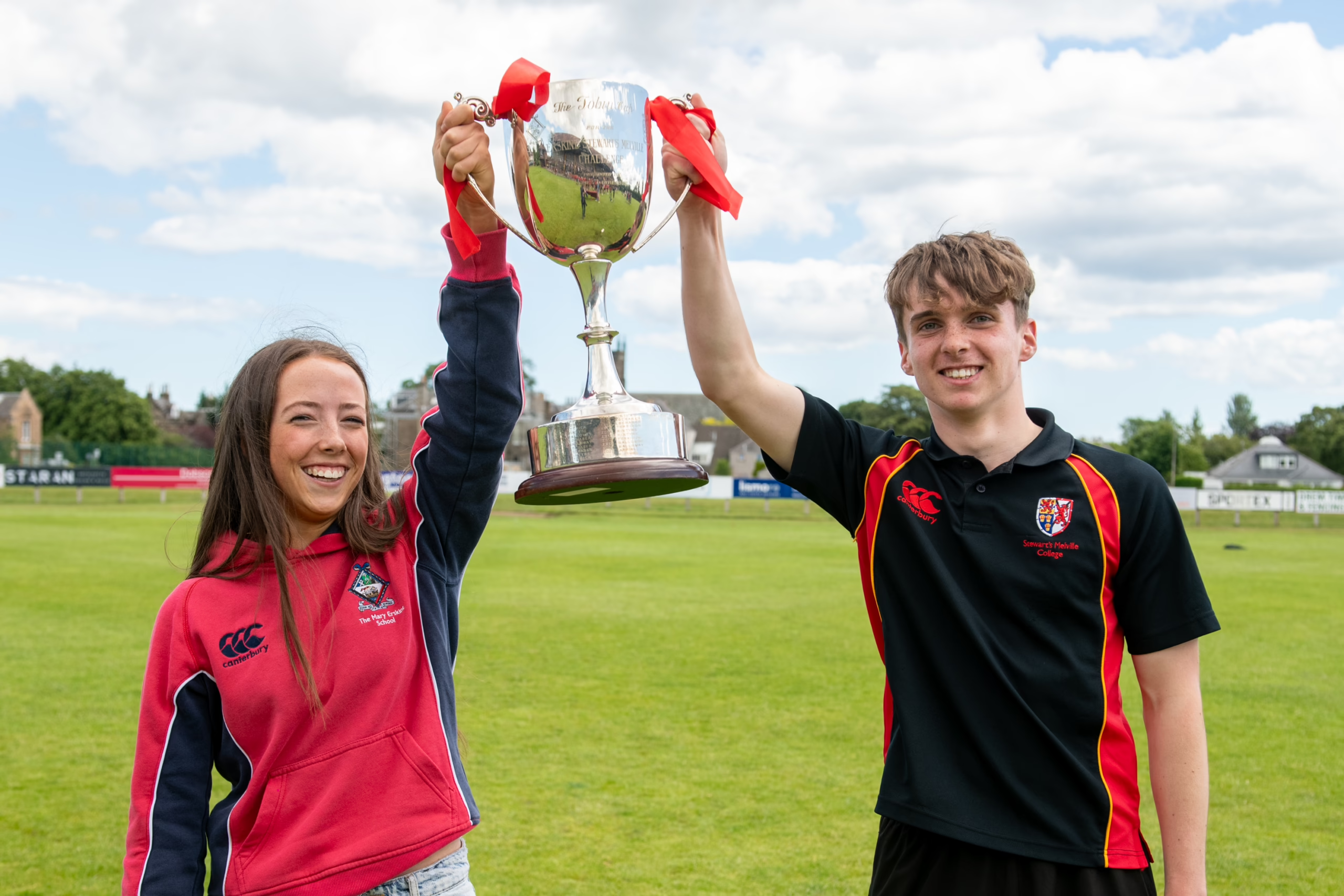
When my parents applied for me and my brothers to join Melville College, the headmaster at the time didn’t like to see siblings split apart. So even though I didn’t have the grades, I was admitted to Melville College so that I could be at school with my brothers so long as I went into the boarding house in Buckingham Terrace. A subsequent headmaster put me on a weekly report card to track progress – which had a considerable influence on me because it was the first time a teacher had shown such interest in my progress as a pupil despite my dyslexia. I also received support from the art master, who encouraged my drawing and artistic skills. This combination of support provided the boost I needed to continue to explore my passions.
What was the most pivotal moment that set you on the path toward architecture and conservation?
A lot of my career path was a tremendous amount of serendipity; however, there were two moments that really stick out which directed my career in historic architecture. The first was when, in 1967, my final year at Edinburgh Art College, half a dozen of us decided to study historic architecture when all the other students were looking at more modern buildings. We surveyed the Grassmarket and the West Bow, and many of the drawings I later deposited in the collections of Historic Environment Scotland. The second moment was after graduating with diploma of architecture (later recognized by the Heriot Watt as a degree) when I saw that the British School of Archaeology in Jerusalem (BSAJ) was looking for an architect to initiate a survey of the Mamluk buildings in the Old City of Jerusalem. I applied for the role on a Thursday, had an interview the following Wednesday in Oxford, got the job and was in Jerusalem within two weeks for a three-month contract. I ended up staying in Jerusalem, off and on, from 1968 until 1975. The many experiences and jobs I have over the last 60 years are attributable to this first job.
Were there any mentors in your early career that influenced your confidence and career trajectory?
Two individuals stand out as foundational mentors during my early career in Jerusalem. The first was my second Director at the BSAJ, Crystal Bennett. She didn’t just open doors; she invested deeply in my development. In 1971, having a flat in Amman and knowing Prince Hassan well, she was instrumental in arranging permission for me to cross the ceasefire lines to give a lecture attended by cabinet ministers and ambassadors, which was broadcast on television and radio. This happened to be my first public lecture. The night before, she had sat with me going through my presentation slide by slide (I had more than 100 at the time!) and helped refine it into something coherent. Over the next four years I was the architect on her excavations at Buseirah, in the south of Jordan. Eventually we were the only two civilians with permanent passes from the Jordanians to cross the bridge from Occupied Palestine to go to Amman. Mentors like her – who combine guidance, protection, and rigorous intellectual support – are extraordinarily rare and profoundly impactful.
Another important mentor was J.P. Ross, the United Nations Development Programme (UNDP) representative in Jerusalem. We met at Government House, the UN Headquarters, and quickly became close friends. He had an exceptional network and seemed delighted to share it. After I left the BSAJ, it was JP who introduced me to UNESCO, which led to several consultancies.
I was fortunate to have been in the BSAJ from 1968-1975; it opened countless doors in worlds I might never have accessed on my own. There were many famous and world-renowned academics who stayed during this period, and I spent time discussing and learning about numerous subjects with them. But it was Crystal who nurtured my confidence and consolidated my academic foundations and cultural connections, and J.P. Ross who broadened my horizons through his diplomatic connections.
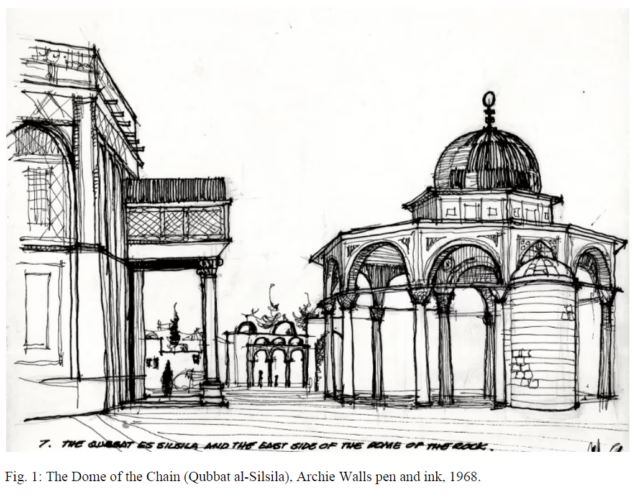
Pen and Ink Drawing by Dr. Walls, 1968
Which skills were most critical for transitioning from student to professional architect?
First and foremost, perseverance. Given my dyslexia and the fact that I spent much of my school career near the bottom of the class, I had to develop a certain stubbornness simply to keep going. From the time I was placed on a permanent report card I learned how to work steadily, even when the text on the page refused to cooperate with me. However, my progress was not a straight line, there were many ups and downs, including enjoyable periods when my social life took precedence! Continual perseverance became the foundation for everything else in my career really from my Jerusalem days.
Observation was another crucial skill – perhaps the architect’s most underrated tool. Looking closely at proportions, shadows and materials became indispensable when I began surveying historic buildings in the Grassmarket and the West Bow during my architecture studies. Careful observation is what allowed me, much later, to detect patterns in mudbrick construction in Oman that hinted at a chronology of techniques, mainly restricted to desert areas, reaching back to the 5th millennium BC. I have since traced this from Zanzibar in the south to Afghanistan in the north, and west to Jordan and Iraq. One consequence of this discovery was that after the ancient mud brick city of Bam was seriously damaged by an earthquake, I was the only Brit invited by the Iranian authorities to attend a conference convened to consider possible restoration methods.
Measured drawing and recording were skills that opened the door to my professional life. My first job with the BSAJ came not because I was the most academically brilliant student, but because I had learned to record historic buildings with accuracy and patience, spending months measuring medieval structures stone by stone. My ability to document buildings in meticulous detail became my calling card and set me on the path toward Islamic architectural history.
And finally, knowing to learn from others. I have been fortunate to encounter people far more knowledgeable than myself: the opportunity to meet Sir Archibald Creswell in Cairo shortly before he passed away, local craftsmen in Baghdad and Oman, brilliant students in Jordan or Sharjah. They taught me techniques, histories and ways of thinking that no formal education could provide. Being willing to listen and learn from others was essential to my development as a professional architect.
In the end, the transition from student to architect was an accumulation of many skills, which has led me to be a lifelong student of historic and Islamic architecture with a number of books and articles to my name.
What led you to focus on historic buildings and Islamic architecture rather than mainstream architectural practice?
Surveying structures in Edinburgh, crawling through timber-framed lofts and measuring medieval masonry, I discovered that I was not only good at this slow, but meticulous work, I loved it. Historic buildings had a texture, a kind of quiet wisdom, that modern projects simply didn’t possess.
Then came working for the BSAJ, and everything opened up. It was in Jerusalem that I first encountered Islamic architecture, not as an abstraction, but as a living tradition. The geometry, the craftsmanship, the relationships between form, function, and spiritual expression – these were unlike anything I had studied in Scotland.
I also discovered that I could be genuinely useful and found myself in places where the survival of traditional building knowledge was precarious. For example, during the Iraq-Iran War and working on the first historic houses to be restored in Baghdad, I ensured that they weren’t covered in cements, but rather their hidden timber frames were exposed and treated, the Farshi brick panels made good and traditional details adhered to in opposition to the accepted proposals. Or in Bahrain at Arad Fort which I excavated and restored over three and a half years. When first shown photographs, I knew I was the only architect that understood the construction technique, based on my previous experience of the mud brick techniques. The Islamic World’s buildings have given me a sense of purpose that mainstream architectural practice never quite matched.
How did working in Jerusalem and later in Jordan, Iraq, and Oman and other Arab countries shape your professional outlook?
I believe the primary reason I was chosen to go out to Jerusalem was my ability to draw, and to focus on the details. At the time I didn’t even know what a mosque was, let alone understand Islamic architecture. It was not a subject taught at art college, everything was either Eurocentric or Modern, understanding Islamic architecture and its details came later, and in fact is still accumulating, through a willingness to learn and observe. That’s what it’s always been about – observation. Whether you’re in finance or any other profession, it helps to use your eyes and intuition and gradually build on your knowledge.
What advice would you give to young professionals, especially those facing academic challenges, about building a successful career?
As far as architecture is concerned, 50 years ago we were still drawing with pencils, I had to draw every stone and measure it – now you can fly a drone over an architectural or archaeological site and get images straight away, but you may miss details simply because everything is there on the screen. If you don’t go into the detail, you miss things. As a recent example, with an American colleague while we were studying some seventh century mosaics, tesserae by tesserae, we discovered an Arabic inscription no one had recorded and which would have been missed if not for focusing on the details.
Everyone is going to have challenges, and the world is going so fast now with AI and with technology, but you must face them to the best of your ability. Whatever you do, do it with love, don’t take shortcuts and just enjoy the excitement of discovery.
Looking back over your career, what has been your favourite project you’ve worked on and why?
In Bahrain, working for the Ministry of Information restoring Arad Fort from 1984 – 1987, I was on site, as archaeologist, architect, mason, carpenter, while managing and overseeing and training up to 150 workers from India and elsewhere. During the restoration, I ensured the use of traditional materials and techniques, to protect the authenticity of the building, including closely following the 40-centimetre-high masonry layered courses, a technique which I had identified a decade before.
Another fascinating project was in England, working with Giles Quarme on Princess Diana’s Memorial Museum at Althorp, the home of her brother Earl Spencer. After she died, we were appointed architects in January and had to finish the work by the first of July. It was a tremendously tight turnaround but equally, it was an incredibly happy project. Everyone from the Earl, the consultants, local authority officials, the contractors and sub-contractors worked with a will to bring the project to a successful conclusion and most importantly be able to welcome 2000 visitors on July 1st.
For current students or recent leavers wanting to follow a similar path, what advice would give them?
I can’t offer much advice, other than to enjoy what you’re doing. That’s the important part – don’t run after the money, do what you love and the rest will follow. You can’t plan everything and some periods will be more successful than others, but the most important thing is to find joy in the journey and capture the opportunities as they arise.
Do you have any final reflections on your career?
Looking back, my career looks like a planned and straight journey, but the journey seen from the other end consists of many branches that required choices and a fortunate series of encounters with people and places that shaped me. I began as a dyslexic schoolboy who barely passed his exams, yet who was fortunately helped by housemasters, colleagues, craftsmen and scholars who saw potential where I often didn’t. Opportunities in Jerusalem, Cairo, Jordan, Baghdad, Oman and other Arab countries came because others opened doors and trusted me to walk through them.
What kept me going was a genuine love of historic buildings – the sense that every structure carries a story, a piece of human ingenuity worth understanding. Islamic architecture gave me a lifelong source of fascination through its geometry, spirituality, and craftsmanship and I’ve simply followed where that fascination led.
If there is one lesson my path illustrates, it is that with the right support and a persistent curiosity, even the most unlikely student can build a meaningful and rewarding life in architecture. I’ve been very lucky and I remain grateful for every person who helped me along the way.