A Shared Approach to Learning
One of our key priorities has been to ensure consistency in the way mathematics is taught across all stages. Staff have worked collaboratively – through professional learning, lesson study, and ongoing dialogue – to build a shared understanding of effective practice.
This has led to the development of a shared approach to mathematics teaching, grounded in three key principles: a focus on deep, conceptual understanding; a strong emphasis on mathematical thinking and discussion; and a clear progression in learning from concrete experiences through to abstract understanding.
In practical terms, this means that students are not simply learning how to carry out calculations but are developing an understanding of why mathematics works. For example, a younger student exploring addition might use physical resources such as counters or cubes to combine groups. They may then draw what they have done before finally recording it using numbers. Older students continue this approach using visual models – such as bar models – to represent more complex problems and explain their reasoning.
In your student’s classroom, this might look like a lesson where they use equipment, drawings, and discussion before moving to written methods, ensuring that understanding is secure at each stage.
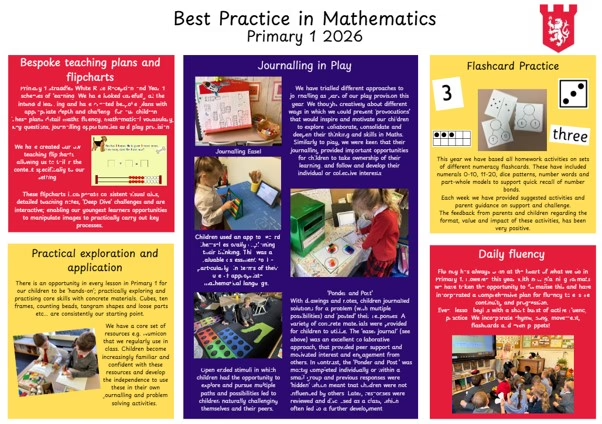
View our Primary 1 best practices in mathematics here.
Learning Through Talk, Exploration, and Challenge
A significant shift in our classrooms has been the emphasis on mathematical talk. Students are now regularly encouraged to explain their thinking, justify their answers, and consider different methods.
You might hear students say:
“I know this because…”
“I solved it in a different way…”
“I noticed a pattern…”
This focus on discussion helps students to clarify their thinking and develop confidence in tackling unfamiliar problems and has been integral to the journalling approach we have trialled across Primary 6 which aims to capture evidence of student’s thinking to support their developing understanding of both the mathematics and themselves as learners.
Alongside this, problem-solving is central to mathematical learning. Rather than practising isolated calculations, students are given opportunities to apply their understanding in meaningful contexts. For instance, instead of simply solving a division calculation, they might be asked to explore how a quantity can be shared, represented in different ways, or solved using multiple strategies.
Depth Over Speed
Another important aspect of our work has been a shift towards depth of understanding. Rather than moving quickly through content, we focus on ensuring that students develop secure and flexible knowledge.
This means that students are regularly encouraged to represent their ideas in a variety of ways, explain and justify their thinking, and explore patterns and connections within their learning. Underpinned by research into how children learn mathematics most effectively, and alongside a continued emphasis on developing fluency, this approach may look and feel different from more traditional methods; however, it is designed to ensure that learning is secure, retained over time, and can be applied confidently in a range of contexts.
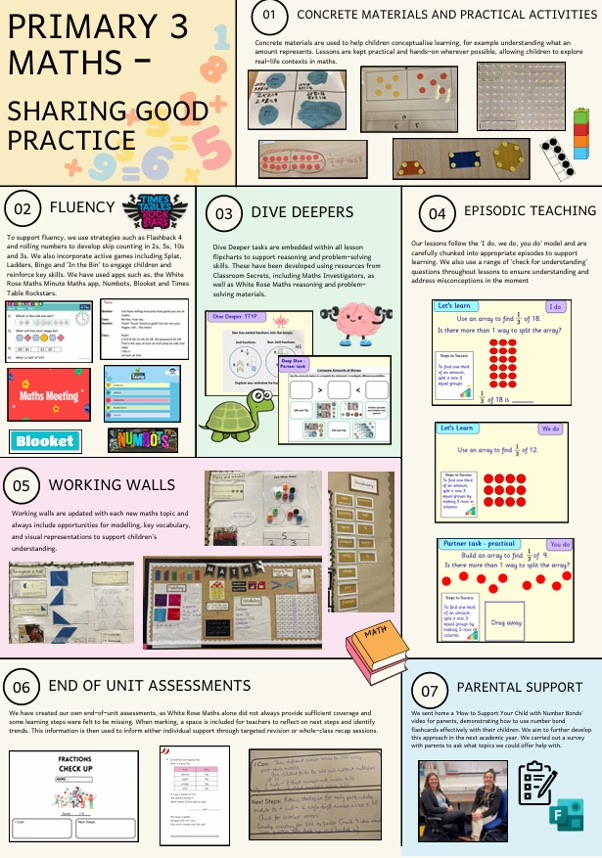
View our Primary 3 best practices in mathematics here.
Supporting Every Learner
Our approach also recognises that students learn in different ways and at different paces. Teachers carefully adapt lessons to provide the right level of support and challenge for all learners.
This might include providing practical resources or scaffolds to support understanding, offering open-ended challenges that deepen thinking, and giving targeted feedback to move learning forward. The aim is to ensure that every student experiences success while also being appropriately challenged and extended in their thinking. Moreover, our use of setting in the upper Primary, alongside targeted Support for Learning interventions, ensure learning is pitched at the right pace for all students.
The Impact in the Classroom
This work is already evident across the school and there is a growing consistency in how mathematics is presented, discussed, and understood. Students are becoming more confident in explaining their reasoning, more willing to engage with challenging problems, and better able to make connections across different areas of mathematics. Just as importantly, they are developing increasingly positive attitudes towards the subject – beginning to see mathematics not simply as a set of rules to follow, but as something to explore, question, and enjoy.
Staff have engaged thoughtfully with this approach in professional learning and have reflected on the impact it has had on their classroom practice, and, in turn, on students’ experiences of mathematics. Colleagues consistently highlight increased confidence in teaching for understanding, greater use of discussion and representation, and a noticeable improvement in students’ engagement, confidence, and willingness to tackle challenges.
View our Primary 6 best practices in mathematics here.
Looking Ahead
While we are proud of the progress made so far, this remains an ongoing journey. We will continue to refine our curriculum, build staff expertise, and ensure that our approach reflects both research and the needs of our learners. Moreover, we will be looking to ensure all students experience the opportunity to ’journal’ and explicitly capture evidence of their thinking as well as host workshops for parents to share more about how we teach mathematics and how you can support your child at home.
By working together in this way, we are ensuring that all students have the opportunity to leave the Junior School with the skills, understanding, and confidence they need to succeed in mathematics and beyond.